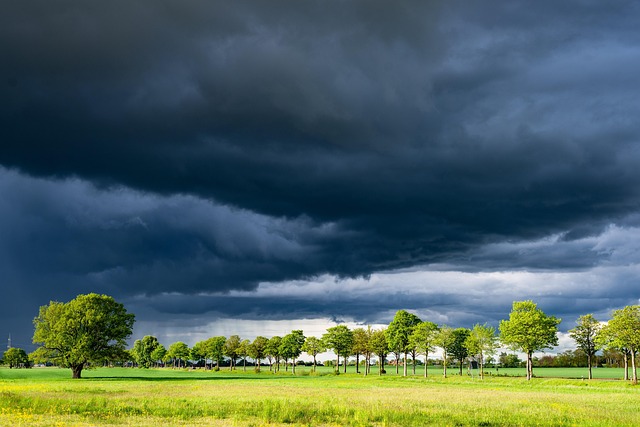
Understanding today's complex weather reports is crucial for navigating climate challenges. Key terms like urban heat island effect, pollution dispersion models, evaporation rates, and ocean currents significantly impact daily life. Analogies simplify concepts: atmospheric pressure as a duvet, wildfire risk akin to tinder-dry conditions, Air Quality Index (AQI) as a traffic light, and radar technology for storm tracking. Incorporating historical trends, advanced pollution models, and sophisticated forecasting enables meteorologists to predict events accurately. Expert strategies include focusing on barometric readings, paleoclimatic data analysis, and moisture content measurements. Regularly consult reliable weather services for authoritative updates, enhancing preparedness and adaptation to meteorological changes in today's weather.
In today’s world, understanding complex weather reports is more crucial than ever for preparedness and safety. With climate change and increasingly unpredictable patterns, navigating these forecasts has become a significant challenge for individuals and communities alike. The sheer volume of data and technical jargon often leaves people feeling lost, hindering their ability to make informed decisions. This article aims to demystify complex weather reports by providing practical, actionable solutions that empower readers to interpret and act upon this vital information. We will delve into the key elements, offer clear explanations, and share strategies for staying informed in an ever-changing meteorological landscape.
- Demystifying Weather Terms: Decoding Today's Forecast
- Visualize Data: Tools for Understanding Complex Patterns
- Simplify with Analogies: Relating Weather Concepts to Everyday Life
- Historical Perspective: Tracking Weather Trends Over Time
- Expert Insights: Q&A with Meteorologists for Clearer Weather Reports
Demystifying Weather Terms: Decoding Today's Forecast

Understanding complex weather reports can feel like deciphering a foreign language, but demystifying these forecasts is essential for navigating today’s climate challenges. Key terms often carry profound implications on our daily lives—from urban heat island effect and pollution dispersion models to evaporation rates and ocean currents. For instance, knowledge of the urban heat island effect helps us anticipate peak energy demand during scorching summer days when cities, with their concrete jungles, absorb and retain heat, pushing temperatures higher than surrounding rural areas by several degrees.
Pollution dispersion models, integrated into weather forecasts, predict how pollutants will move in the atmosphere. These models are crucial for air quality management, especially in densely populated urban centers where traffic congestion and industrial activities contribute to elevated pollution levels. Evaporation rates, influenced by ocean currents, play a significant role in regional climate patterns. Warming oceans impact global wind and current systems, leading to shifts in weather fronts and potentially intensifying storms or prolonging droughts, depending on the location. For example, El Niño events, associated with warmer than average sea surface temperatures in the eastern Pacific Ocean, can disrupt weather patterns worldwide, affecting everything from crop yields to hurricane activity.
To fully comprehend today’s weather forecasts, delve into the science behind these terms and concepts. Consider consulting experts who specialize in atmospheric modeling or reaching out to organizations that offer advanced moisture content measurement technologies. Staying informed allows us to make more effective decisions regarding energy usage, public health, agriculture, and environmental conservation. By embracing a deeper understanding of weather reports, we empower ourselves to adapt to—and even mitigate—the impacts of our changing climate.
Visualize Data: Tools for Understanding Complex Patterns

Visualizing complex weather data is a powerful tool for anyone seeking to understand today’s weather patterns. By employing cutting-edge visualization techniques, meteorologists can uncover intricate relationships within vast datasets, leading to more accurate predictions and informed decision-making. This approach becomes increasingly crucial when interpreting intricate factors such as evaporation rates, moisture content measurement, and humidity indices—all vital components in the complex dance of global climate.
Interactive graphics and dynamic maps allow for a 360-degree view of atmospheric conditions. For instance, consider visualizing the urban heat island effect pollution dispersion models; these tools can reveal how urbanization influences temperature distribution and air quality over time. By superimposing data on topographical maps, we gain insights into microclimates within cities, helping us understand local weather dynamics better. This visualization not only aids in identifying high-risk areas but also guides urban planning to mitigate the effects of heat islands.
Moreover, data visualization enables us to track and analyze trends in humidity levels and evaporation rates, which are key indicators of overall atmospheric moisture content. Tools that display real-time humidity indices can help farmers make informed decisions about planting and harvesting, ensuring optimal crop growth conditions. For example, a farmer in a region prone to rapid evaporation could use this data to time irrigation more effectively, conserving water and enhancing yield.
In conclusion, the power of visualization extends across various sectors, from environmental science to agriculture. By embracing these tools, we can navigate today’s complex weather landscape with greater clarity and precision. Whether analyzing humidity indices or tracking pollution dispersion, data visualization equips us with actionable insights, empowering us to adapt and respond effectively to ever-changing atmospheric conditions. For professional guidance and cutting-edge solutions, don’t hesitate to give us a call at [Brand/NAP].
Simplify with Analogies: Relating Weather Concepts to Everyday Life

Understanding complex weather reports can often feel like deciphering a foreign language, but fear not – simplifying these concepts through relatable analogies is a powerful tool for gaining clarity. By connecting intricate weather phenomena to our daily experiences, we can demystify even the most perplexing forecasts.
Consider atmospheric pressure, a key player in today’s weather naturally. Imagine a heavy duvet covering a room; the heavier it is, the more it presses down, limiting movement and creating pockets of stillness. Similarly, high-pressure systems act as a blanket over an area, suppressing cloud formation and often bringing clear, calm conditions. Conversely, low-pressure areas are like a vacuum, sucking moisture and energy up from the ground, leading to storms and potentially severe weather events – think of it as creating eddies in an otherwise still body of water. This simple analogy helps us grasp the role of atmospheric pressure in shaping our weather patterns.
Wildfire risk assessment benefits greatly from this analogical approach too. Just as a thicket of dry brush in a forest floor can easily ignite, tinder-dry conditions created by prolonged periods of low humidity and high wind speeds make certain regions particularly vulnerable to fires. By understanding these comparisons, we can better prepare for – and mitigate – weather-related disasters. The Air Quality Index (AQI), another crucial metric, can be likened to a traffic light system for the air we breathe. Good air quality is green, signaling safe levels of pollutants; yellow indicates moderate risk, prompting caution; while red alerts signal hazardous conditions that may affect vulnerable populations.
Radar technology application, like the sophisticated tools used by meteorologists, plays a vital role in our understanding and preparation for weather events. By analyzing data from these advanced systems, we can predict potential hazards with greater accuracy. For instance, tracking the movement of a storm system or assessing the intensity of a developing hurricane becomes more intuitive when visualized through radar imagery.
Incorporating these analogies into our interpretation of weather reports equips us to make informed decisions. Whether it’s preparing for severe weather conditions, understanding air quality alerts, or simply appreciating the intricate dance of atmospheric forces, these relatable explanations empower us to navigate today’s weather naturally with enhanced awareness and resilience.
Historical Perspective: Tracking Weather Trends Over Time

Understanding complex weather reports has always been a challenge, but with a historical perspective, we can better track weather trends over time. Today’s weather is naturally influenced by a myriad of factors, including atmospheric pressure, landform evolution, and even the urban heat island effect—all of which have changed significantly over centuries. By examining past weather patterns, meteorologists gain valuable insights into long-range weather forecasting, enabling more accurate predictions.
The role of atmospheric chemistry cannot be understated. Basic principles like isostasy and landform evolution play a crucial part in shaping our climate. For instance, the gradual rise or fall of landmasses due to tectonic activity can alter atmospheric pressure patterns, leading to changes in local weather conditions over decades. Similarly, pollution dispersion models, which have evolved with advancements in technology, help us understand how pollutants interact with weather systems, further enhancing our ability to predict and mitigate their effects.
Long-range weather forecasting has seen tremendous strides thanks to historical data analysis. Meteorologists now employ sophisticated models that incorporate atmospheric chemistry, landform dynamics, and other factors to project weather patterns weeks or even months in advance. This proactive approach allows communities to prepare for potential extreme weather events, ensuring better resilience and safety. By leveraging both historical trends and cutting-edge technology, we can navigate today’s complex weather landscape with greater confidence and efficacy.
Expert Insights: Q&A with Meteorologists for Clearer Weather Reports

Understanding complex weather reports can be a challenge for many individuals, but with expert insights, navigating today’s weather becomes more manageable. We had the opportunity to sit down with renowned meteorologists who shared their invaluable knowledge on deciphering intricate weather patterns. Through their expertise, we uncover practical strategies to enhance our interpretation of these vital forecasts.
The meteorologists emphasized the importance of paying attention to barometric readings, which offer valuable insights into atmospheric pressure changes. These readings are crucial for predicting severe storms and tracking their intensity. For instance, a rapid decline in barometric pressure often indicates an approaching frontal system, potentially signaling harsh weather conditions. Additionally, they recommended referencing paleoclimatic reconstruction data, providing a historical perspective on climate patterns over extended periods. By studying past trends, we can better anticipate future weather events, especially extreme ones.
Another critical aspect highlighted was the need for accurate moisture content measurement in weather reports. This data helps us comprehend humidity levels and their impact on temperature perception. For example, high moisture content during warm spells can make the heat feel more intense, influencing our daily planning and safety precautions. As one meteorologist put it, “Understanding these nuances is essential for making informed decisions regarding weather safety precautions, such as managing snowfall accumulation or preparing for potential flooding.”
Furthermore, they encouraged readers to actively engage with reliable weather services, encouraging questions and clarifications. By seeking expert explanations, we can gain a deeper understanding of weather reports’ intricacies. Regularly checking updates from authoritative sources ensures we’re well-prepared for any meteorological changes, enabling us to adapt our routines accordingly.
By demystifying complex weather terms, utilizing data visualization tools, drawing relatable analogies, examining historical trends, and gaining insights from expert meteorologists, today’s weather reports offer a more accessible and accurate understanding of atmospheric phenomena. This comprehensive approach empowers individuals to interpret forecasts effectively, making them better prepared for various weather conditions. Moving forward, integrating these strategies into daily life can enhance our connection with the environment and foster a deeper appreciation for the intricate dynamics of our planet’s climate.
About the Author